Chapter Six: Romper el Coco/Crack Open the Coconut
1944: The first recordings on Panart captured a moment that marked the modernization of Cuban song.

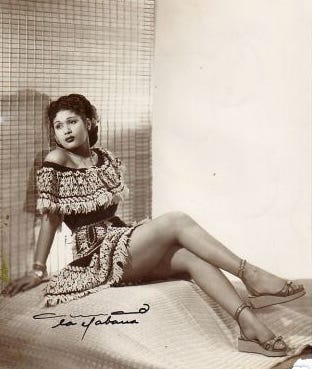
“What else can poor people do but sing, and keep singing?” reasoned Olga Guillot, looking back at her childhood from the firmament of stardom as one of the greatest Latin American vocalists of all time. The future Queen of Bolero and her sister Ana Luisa didn’t play with dolls. In the family’s rented room in a colonial-style tenement building set around a communal patio, they sang to amuse themselves. Even as toddlers, they were the tiny back-up singers for their mother, who worked as a seamstress to precariously support her two daughters on her own. They always sang while she sewed. Their aunt was also featured in the household chorus. The girls joined her in singing Spanish romantic arias from the zarzuelas, lyric operas then popular in Cuba, as they went about their daily chores. The show business aspirations once nurtured by Guillot’s mother and aunt had been thwarted by their father, Guillot’s grandfather, a Sephardic immigrant from Catalunya who worked as a tailor. He forbid his daughters to sing for a living. “I don’t want prostitutes in my house,” he declared. And that was final.
The Guillot sisters Olga and Ana Luisa won second prize in 1938 appearing on the radio contest La Corte Suprema del Arte, then the most viral launching pad for talent in Havana. They took home a box of chocolates and twenty-five dollars. Olga later recalled how she was discovered by the celebrated Spanish-born Cuban tenor Mariano Meléndez. He heard her voice through the ground-floor open window as he walked through Old Havana’s Belén neighborhood on one song-filled afternoon among so many in Guillot’s childhood.
In a conversation with Cuban author Armando López published in 2009 in the exile cultural magazine Cuba Encuentro, the diva recounted the fond memory of her subsequent public debut at age seven on the stage of a theater in the historic Guanabacoa district, which was known as El Salon de Ilusiones before it became the popular cinema Teatro Carral, where the iconoclastic Afro-Cuban pianist Bola de Nieve would get his break accompanying silent films. In a flounced rumba dress, Guillot sang “El Manisero.” It was the tune, known in English as “The Peanut Vendor,” that broke the American market open to Latin music in the thirties after it was premiered by Don Azpiazú’s orchestra at Manhattan’s RKO Palace Theater. Her mother had often sung composer Moisés Simon’s song inspired by Havana’s street sellers after Cuban star Rita Montaner first recorded it in 1928 and made it a radio hit in Cuba.
As Guillot remembered it, when she walked into the Panart studio for the first time she was 16 years old.
“I was just a little sprite then,” Guillot, who died in 2010, told me when I reached her by phone at her home in Miami one morning in 1996.
To continue reading this latest chapter of my book Cuba on Record, the story of Cuba’s first and forgotten record label, and previous and future chapters including playlists and vintage photos and videos, please consider becoming a paid subscriber, or joining my premium subscriber group, the Cuba on Record All Stars.
By subscribing, you support my work to continue to uncover and document the story of Panart Records, and other forgotten histories of Cuban music. Time is of the essence as I track down and interview artists and other eyewitnesses-before they are gone forever. GRACIAS